No, I Won’t Double Your Money by Christmas: A Trader’s Family Dinner Survival Guide
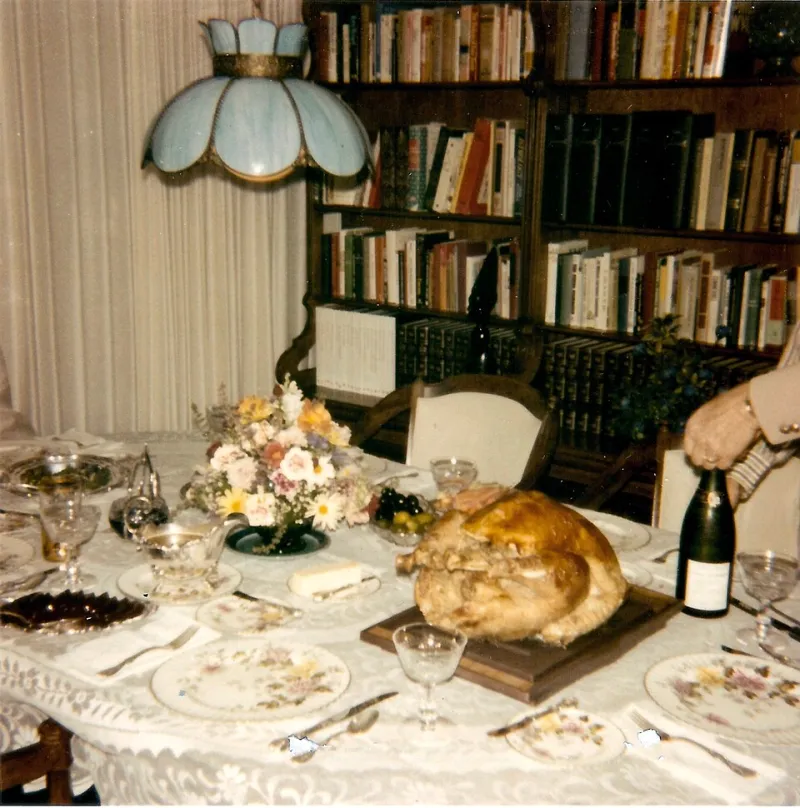
Photo: Per source. Please credit "Family photos of Infrogmation"., CC BY-SA 4.0, via Wikimedia Commons
Thanksgiving 2026 is going to smell like turkey, sound like football, and at some point feature a relative leaning across the mashed potatoes to ask what you’re buying. It’s not malicious. It’s curiosity mixed with free-advice syndrome. But for a retail trader—especially one running a small account—it can feel like a pop quiz with your entire family watching.
Here’s the uncomfortable truth: most of those questions aren’t really about a ticker. They’re about hope. Uncle Rick heard someone on a podcast say the market always goes up. Your cousin wants to turn $500 into a down payment by spring. A well-meaning aunt thinks trading is just a app-based version of a savings account. And you? You’re the person at the table who actually looks at charts, so suddenly you’re the family’s unpaid financial advisor.
You don’t have to accept that job. In fact, the healthiest thing you can do for your capital and your relationships is to decline it politely, clearly, and without launching into a 20-minute lecture on position sizing.
The Ask Is Rarely About the Stock
When someone asks for a hot pick, they’re usually asking for certainty. They want you to say, “This one will go up,” so they don’t have to sit with the discomfort of not knowing. That’s a human thing. It’s also a trap.
If you give a pick and it wins, you become the family’s trading hotline. If you give a pick and it loses, you become the reason someone’s holiday budget got smaller. Neither outcome is good. The best trading crews—the ones that actually last—learn to separate education from advice. You can explain how you think about a trade without telling anyone what to do with their money. That’s the line to hold at dinner.
Four Lines That End the Cross-Exam
You don’t need to be clever in the moment. You need a few lines you can repeat calmly while passing the rolls. Here are word-for-word responses that work in most family settings.
The polite deflect: “I don’t give picks anymore. I’m happy to talk about how I manage risk, but I won’t tell you what to buy.”
The group-trade shutdown: “I don’t mix family money with trading. It’s a rule I keep for both of us.”
The manage-my-money no: “I’m not licensed for that, and honestly, I don’t want the job. I’d rather keep you as family.”
The door-open-but-not-to-that: “If you want to learn, I’ll show you my process. But I’m not handing you a trade.”
Notice what these lines don’t do. They don’t shame the person asking. They don’t promise a result. And they don’t require you to explain every indicator you’ve ever used. They simply set a boundary and leave the relationship intact.
The One-Breath Risk Explanation
Sometimes a flat no feels rude, especially if the person asking is genuinely curious. That’s when a simple risk framework helps. Keep it to three parts: what it is, what it can do, and whose money it is.
Here’s how it sounds at the table: “Trading is a way to lose money quickly with the chance of making some. I risk a small fixed amount, I can be wrong five times in a row, and it’s my money—not ours.”
That’s it. You’re not teaching a course. You’re not predicting the market. You’re explaining that risk is real, losses are normal, and the account is yours to manage. If someone pushes past that, they’re not looking for education. They’re looking for a guarantee, and you don’t have one to give.
Boundaries You Can Set Before the Doorbell Rings
A holiday boundary works better when you decide it before the first appetizer appears. Use this checklist as a pre-dinner reset.
- Pick one sentence you’ll use for picks and one sentence you’ll use for money management requests.
- Tell your partner or spouse your plan so you’re not improvising in front of an audience.
- Decide in advance that you won’t open your brokerage app at the table, not even to “just show them.”
- No promises about returns, timelines, or “safe” trades. Not even joking ones.
- If a conversation starts heating up, change the subject with a question: “How’s the new job?” works surprisingly well.
- Offer education, not instructions. A book recommendation or a basic risk article is fine. A buy signal is not.
- Give yourself permission to leave the room. “I’m going to grab more coffee” is a complete sentence.
What to Do If Someone Won’t Let It Go
There’s always one relative who treats a boundary like a debate invitation. Maybe they’ve had a few glasses of wine. Maybe they’re convinced you’re hiding the good stuff. Either way, don’t take the bait.
Use the broken-record method. Repeat your line in the same calm tone. “I don’t mix family money with trading.” If they ask why, give the short version: “Because it’s a quick way to ruin both.” If they keep pushing, excuse yourself and refill your water. You’re not responsible for managing their disappointment.
And if they ask you to manage their account? That’s an easy one. “No. I’m not doing that.” You don’t need to soften it with a maybe or a someday. You’re a retail trader, not a registered investment advisor. More importantly, you’re family. Keeping those roles separate is a kindness.
The Real Win Is Keeping Both
The holiday table isn’t a trading floor. Nobody needs a breakout strategy between the stuffing and the pie. What they need—and what you need—is a calm, clear answer that protects your capital and your relationships.
At TradeFrat, we talk a lot about trading with a crew that checks you. Your family can be part of your support system without being part of your portfolio. Let them cheer for you. Let them ask questions. Just don’t let them talk you into a trade, and don’t let yourself talk them into one either.
You don’t have to be the family’s unpaid financial advisor. You just have to be the trader who survives to trade Monday. Pass the gravy. Keep the ticker to yourself.